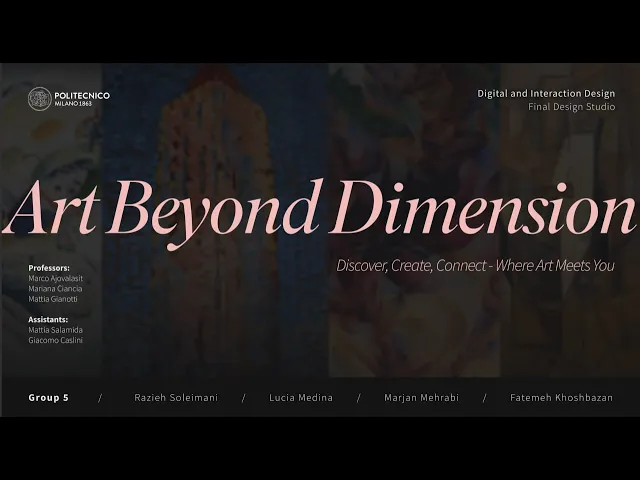

Art Beyond Dimension
Art Beyond Dimension
Art Beyond Dimension
Art Beyond Dimension
AI-powered immersive museum experience enabling visitors to interact with artworks and transform them through generative systems.
Digital & Interaction Design
Politecnico di Milano – Final Design Studio
Team Project: Fatemeh Khoshbazan, Lucia Medina, Marjan Mehrabi, Razieh Soleimani.
Role: UX Research, Interaction Design, UI Design, Prototyping

Rethinking Museum Experiences for a Digital Generation
Younger audiences often perceive traditional museums as static and impersonal.
At Museo del Novecento, we identified limited digital interaction, lack of personalization, and minimal engagement with emerging technologies.
Many visitors focused on taking photos rather than deeply connecting with the artworks.
Our goal was to bridge cultural heritage and digitally native audiences through meaningful, interactive design.
Video of the project
How might we transform museum visits into interactive and creative experiences that deepen emotional connection with artworks and foster greater appreciation of cultural heritage?
Video of the project
How might we transform museum visits into interactive and creative experiences that deepen emotional connection with artworks and foster greater appreciation of cultural heritage?
Video of the project
How might we transform museum visits into interactive and creative experiences that deepen emotional connection with artworks and foster greater appreciation of cultural heritage?
From Layered Screens to Interactive Creation
Our initial concept introduced a transparent digital layer in front of existing paintings.
User testing revealed critical issues:
– It blocked physical access
– It disrupted the relationship with the original artwork
– The experience felt visually intrusive
We reframed the concept toward a system that empowers visitors to actively create rather than passively consume.


The Experience
Visitors explore artworks through an interactive stand positioned within the museum space.
They can:
– Ask personalized questions about the artist and artwork
– Transform paintings using AI-powered prompts
– See their generated artwork projected in real time
– Download or print their personalized creation
The experience merges physical presence, AI interaction, and collective visual display.

Interaction Flow
The interaction is structured around three main phases:
Explore: Users browse selected paintings and access contextual information.
Ask: Visitors interact through voice or touch, receiving AI-generated answers tailored to each artwork.
Transform: Users modify the painting through style options or custom prompts, generating a new artwork in real time.
The final creation can be projected, downloaded, or printed as a personalized postcard.
Visitor Journey in Space
A visitor approaches the installation, notices the projected collective artworks, and begins exploring a painting. Through touch or voice, they ask questions, receive contextual insight, and are invited to transform the artwork using guided or personal prompts. Their creation is projected in real time and becomes part of a continuously evolving collective display.The moment concludes with a tangible memory — a printed or digital version of their artwork.
The installation transforms observation into participation.

System Architecture
The system integrates multiple AI-driven components: Touch and voice input, Natural Language Processing (LLM), Generative image model (GAN-based transformation), Real-time projection display, QR-based download and print system
This architecture enables a seamless loop between user input, AI processing, and physical output.

Prototype Development
We developed low-, mid-, and high-fidelity prototypes to test interaction clarity, engagement level, and system usability.
The final interface balances guided options with user-generated prompts to reduce cognitive load while maintaining creative freedom.
Prototype Development
We developed low-, mid-, and high-fidelity prototypes to test interaction clarity, engagement level, and system usability.
The final interface balances guided options with user-generated prompts to reduce cognitive load while maintaining creative freedom.

User Validation
30 users tested the system during the Madness event. Key insights:
– Users preferred the transformation feature over passive information
– Personalized questions increased engagement
– The experience worked well socially (friends and couples interacting together)
– Average satisfaction rating: 4.33 / 5
The testing phase led to refinement of screen hierarchy and projection usage.

Reflection
This project deepened my exploration of AI-enhanced interaction systems within physical environments. I became increasingly interested in how intelligent systems can structure immersive experiences without overpowering human agency. Designing this installation reinforced my focus on Immersive interaction, AI-mediated environments and Future-facing physical interfaces.